

Could Telecommunications Companies Help Build Water Security in the Pacific?
Author: Dr Mark Love, Research Fellow (IWC), 23 March 2026
Water security is the ability of Pacific communities to protect and sustainably manage their water resources, while maintaining access to safe water, sanitation, and hygiene for all, and managing the water-related risks of disasters and climate change, to support a healthy, prosperous, and resilient Pacific (SPC, 2026). Critically, it depends not only on infrastructure, but on whether communities undertake maintenance, support local leadership, conserve water, include women and young people in decision-making, and see water management as a shared and priority responsibility. Scholarship has long argued that societies must manage water-related risks over time, not merely access infrastructure at a single point (Grey & Sadoff, 2007).
In the Pacific, that challenge is intensified by dispersed populations, remote islands, fragile service systems, and high exposure to climate variability and disasters. The region is not on track to meet SDG 6 targets (UNICEF Pacific, 2023; WHO/UNICEF JMP, 2023).
The dominant approach to rural water delivery across the Pacific is community-based management – volunteers trained and handed responsibility for local systems after minimal preparation. In practice, most water committees struggle with continuity, financing, maintenance, inclusion, and collective action (e.g., Bond et al., 2015; Hutchings et al., 2017; World Bank, 2017). Evidence from Fiji, Solomon Islands, and Vanuatu consistently shows that effective water management depends on sustained motivation, locally appropriate communication, ongoing financial inputs, and – most critically – continued follow-up support well beyond initial training and handover (Love, 2023; Souter et al., 2024). This is often described as “community management plus” (Baumann, 2006; Hutchings et al., 2015).
Water security in the Pacific is therefore as much a management and public engagement challenge as it is a technical or infrastructure one. Here, social marketing approaches that can influence attitudes towards collective water action and raise awareness beyond committee members alone is important.
What telcos have that WASH doesn’t
Telecommunications companies in the Pacific, such as Digicel, Vodafone, Our Telekom, already have something that most water and sanitation programs spend years trying to acquire: reach, frequency, and familiarity. They can put a message or video directly into someone’s hand very quickly. They can repeat it often, to remind people of the importance of that message. And because people use their phones constantly, messages arriving through SMS, Facebook, or Instagram don’t feel like development programming, they feel like everyday life. 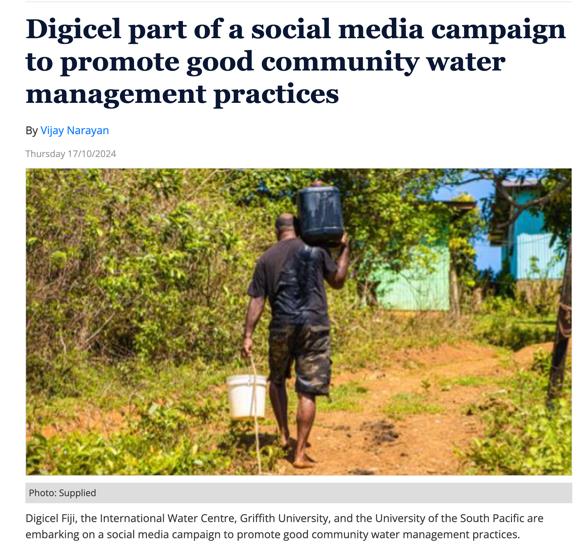
From a behaviour change perspective, that matters enormously. Information alone rarely shifts what people do. What moves behaviour is salience – whether something feels relevant and important – combined with repetition, social norms, and a clear, emotionally resonant reason to act (Andreasen, 2002). Telcos are unusually well-positioned to deliver all of that, at scale, at relatively low cost, and in a timely fashion.
And it turns out, they can be willing. During the Pacific Community Water Management Plus (PaCWaM +) applied research, IWC and its partners (SINU and USP Fiji) developed a series of resources around the “Water is Everyone’s Business” concept, including a pilot digital social marketing campaign. Digicel Fiji, Vodafone Vanuatu, and Our Telekom in Solomon Islands were all approached as partners – and all expressed genuine interest. Water, health, and environmental wellbeing map naturally onto existing corporate social responsibility priorities. Digicel’s own CSR focus areas include health, education, and environment. The partnership model isn’t just theoretically attractive; it’s institutionally feasible.
Lessons From the Fiji Pilot
A four-week pilot conducted with Digicel Fiji offered the first direct test of this approach (Digicel Fiji, 2024; Fiji Village, 2024). Using Facebook, Instagram, and weekly SMS blasts, the campaign addressed four themes central to a water security agenda: self-reliance, collective action, water conservation, and social inclusion. The framing was deliberate. Water security weakens when communities do not mobilise funds for maintenance, when governance depends on a small number of volunteers, when water is wasted during dry periods, or when women, youth, and people with disabilities are excluded from water decision-making. The campaign tried to make these dynamics visible as shared civic concerns. (Water is Everyone’s Business videos)
In terms of reach and engagement, Facebook outperformed Instagram. Video content performed best across formats. SMS helped extend access to users beyond social media channels. The campaign was conducted alongside a broader community grant/competition run by Digicel, which generated 81 community development proposals, of which 36 were completed (Shrestha et al., 2024).
An important limitation of the pilot is that it didn’t assess the sustainability of these changed behaviours. Moreover, this was an action research pilot, undertaken with very limited finances and capacity, limiting the duration and scale of communications, and capacity for evaluation. Nevertheless, the pilot showed that telecom-enabled public engagement can generate meaningful visibility and community interest around water issues – and also surfaced clear operational lessons. Shorter posts outperformed longer explanatory ones. “Calls to action” need to be more specific to convert attention into greater participation. Platform choice matters: Instagram requires faster, more visual content, while Facebook appears better suited to broader public engagement in this context. These are not minor communications tweaks. They are the operational details that can turn digital awareness raising from passive broadcasting into active public interest. In short, our operating research question – Does social marketing (in the context of rural water management) have merit in the PIC context? – was answered in the affirmative (Shrestha et al., 2024).
Not a Silver Bullet, But a Serious Tool
None of this replaces the hard, slow work of building capable local institutions, ensuring adequate resourcing, providing technical support, mentoring and the all-important follow-up that keeps community systems functioning after installation or training. But that is exactly why telecom partnerships are worth exploring: not as a substitute for the steady professionalisation of rural water service delivery but as a practical, scalable and relatively low-cost way to raise the visibility, social status and perceived relevance of water security and management alongside broader WASH investments. With the right content and the right partners, telecom networks can help move water security from the margins of project implementation to the centre of public conversation (Shrestha et al., 2024; Souter et al., 2024).
In that sense, the case for telecom partnerships is simple. Water security depends on infrastructure, but it also depends on attention. And in the Pacific, telecoms may be one of the most effective ways to build that attention at scale.
The PaCWaM+ research project was part of the Australian Government’s Water for Women Fund, 2018-2025.


References
Andreasen, A. R. (2002). Marketing social marketing in the social change marketplace. Journal of Public Policy & Marketing, 21(1), 3–13. https://doi.org/10.1509/jppm.21.1.3.17602
Bond, M., Tyndale-Biscoe, P., Clark, K., Francis, N., Nott, T., Galing, K. and Blackett, I. 2015. The sustainability of rural water, sanitation and hygiene in Papua New Guinea. Water: Journal of the Australian Water Association, 42(6): 42-4.
Digicel Fiji. (2024). Pacific Community Water Management + Fiji. Digicel Pacific. https://www.digicelpacific.com/mobile/fj/promotions/pacific-community-water-management-fiji
FijiVillage. (2024, October 17). Digicel part of a social media campaign to promote good community water management practices. https://www.fijivillage.com/news/Digicel-part-of-a-social-media-campaign-to-promote-good-community-water-management-practices-8xr5f4/
Grey, D. and Sadoff, C.W., 2007 . Sink or swim? Water security for growth and development. Water policy, 9(6), pp.545-571. https://doi.org/10.2166/wp.2007.021
Hutchings, P., Chan, M.Y., Cuadrado, L., Ezbakhe, F., Mesa, B., Tamekawa, C. and Franceys, R., 2015. A systematic review of success factors in the community management of rural water supplies over the past 30 years. Water Policy, 17(5), pp.963-983.
Hutchings, P., Franceys, R., Mekala, S., Smits, S., James, A.J. 2017. Revisiting the history, concepts and typologies of community management for rural drinking water supply in India. International Journal of Water Resources Development, 33, 152-169.
Shrestha, S., Pene, S., Souter, R., Cagi, T., Kumar, N., and Love, M. 2024. Social Marketing for prioritising community water management in the Pacific Islands: Results of a campaign in Fiji. International WaterCentre, Griffith University; The University of the South Pacific.
Souter, R.T., Ruuska, D., Pene, S., Benjamin, C., Sheila, F., Beal, C., Sanderson, R., Batikawai, S., Ravaic, A., Antoinette-Wickham, T., Rankin, T., Peter, L., Molitambe, H., Theophile, G., Shrestha, S., Kotraj, K.K., Buguro, H., Panda, N., Deo, V., and M. Love, (2024). Strengthening rural community water safety planning in Pacific Island countries: Evidence and lessons from Solomon Islands, Vanuatu, and Fiji. Journal of Water and Health; jwh2024144. https://doi.org/10.2166/wh.2024.144
The Pacific Community (SPC), (2026, in press). Water Security Engagement Strategy.
UN-Water. (2013). Water security and the global water agenda: A UN-Water analytical brief. United Nations University. https://www.unwater.org/sites/default/files/app/uploads/2017/05/analytical_brief_oct2013_web.pdf
UNICEF Pacific (2023). Financing Water, Sanitation and Hygiene in the Pacific. UNICEF Pacific, Suva. July 2023. https://www.unicef.org/pacificislands/press-releases/unicef-calls-greater-investment-water-and-sanitation-pacific
WHO/UNICEF Joint Monitoring Programme (JMP). A Snapshot of Water and Sanitation in the Pacific Islands. 2023. https://www.unicef.org/eap/media/17771/file/Pacific%20Snapshot%202023.pdf
WHO/UNICEF Joint Monitoring Programme. (2021). Progress on household drinking water, sanitation and hygiene: Pacific region and Pacific Islands, 2000–2020. WHO/UNICEF Joint Monitoring Programme for Water Supply, Sanitation and Hygiene. https://washdata.org/sites/default/files/2022-03/unicef-2021-regional-snapshot-Pacific.pdf
World Bank Group. (2017). Sustainability Assessment of Rural Water Service Delivery Models: Findings of a Multi-Country Review. World Bank, Washington, DC.